|
|
| Line 1: |
Line 1: |
| − | [[Image:Seamonsterbissette09.jpg|thumb|500px|The Connecticut River Monster, in its natural habitat—the riparian areas of the Connecticut and White Rivers. Reconstruction by Steve Bissette, 2009, c.e.]]
| |
| − |
| |
| − | == Connecticut River Sea-Monster==
| |
| − |
| |
| − | ==The Carcass==
| |
| − |
| |
| − | '''Connecticut River Monster,''' (''Hydrohippokampos athesphatos lymanae'') previously unknown biological classification, formerly or sometimes still known as "Connecticut River Sea Monster" embalmed aquatic/amphibious specimen. Wax and baling wire. Illuminated. Custodian and interpretive administrator: Gulgo Vandersheltz Bargain.
| |
| − | <br>Too much as already been both said and written about this Aquatic Fauna specimen. Mysterious in origin and somewhat contumacious in aspect, he—or she—remains one of the most popular exhibits in the Museum.
| |
| − | <br>A selection of press and signage accompany the specimen in the Museum's exhibition room, case XDIV.
| |
| − |
| |
| − | fa.1994.65.em (''Pre-1997 catalog'')
| |
| − |
| |
| − | [[Image:Seamonsterskeleton09.jpg|thumb|300px|The Connecticut River Monster skeletal structure, as depicted by Mr. Scott Mardis. 2000, c.e.]]
| |
| − |
| |
| − | ==Specific Dimensions==
| |
| − |
| |
| − | [[Image:Seamonsterwithhair.jpg|thumb|300px|Reconstruction of the fleshy parts, by Scott Mardis, 2000, c.e.]]
| |
| − |
| |
| − | Total length from tip of snout to end of tail: 8 ft., 5 inches.
| |
| − | <br>Length of skull: 18 inches
| |
| − | <br>Length of lower jaw: 15 inches
| |
| − | <br>§12 teeth in upper jaw, 6 each side. 12 teeth in lower jaw, 6 each side.
| |
| − | <br>Length of ears: 5 inches
| |
| − | <br>Length of neck: 2 ft. 18 neck vertebrae
| |
| − | <br>Length of torso: 1 ft., 8 inches, 14 torso vertebrae
| |
| − | <br>Abdominal ribs, 6 pairs. Each rib 11.5 inches
| |
| − | <br>Length of arm (humerus) bones: 8.5 inches
| |
| − | <br>Shoulder girdle, foot and finger bones missing
| |
| − | <br>Length of leg (femur) bones: 11 inches
| |
| − | <br>§Foot and toe bones missing
| |
| − | <br>Length of tail, 15 tail vertebrae: 4 ft., 9 inches
| |
| − | <br>§Some of the teeth are missing but the above numbers are what would have been there if the carcass was complete.
| |
| − |
| |
| − | [[Image:Seamonsterlecture.jpg|thumb|300px|Main Street Museum director David Fairbanks Ford describes the Connecticut River Sea-Monster in a lecture given at the University of Vermont, 2000, c.e.]]
| |
| − |
| |
| − | ==Exhibition==
| |
| − |
| |
| − | The Carcass of this unusual specimen was originally exhibited in a vitrine, far to small for the creatures dimensions, in the front room of the Main Street Museum, in its Headquarters on South Main Street, the former "Lena's Lunch" Building. At this time, in 1996, the owners of the Hotel Coolidge allowed the beast to be exhibited in the dining room of their establishment, during a fundraising dinner for "Riverfest."
| |
| − |
| |
| − | These exhibits proving so financially lucrative for the Museum, a ponderous vitrine was produced, featuring neo-classic elements and a commodious chamber which allowed the specimen to be observed and studied to its full measurements. At this time, Professor Gulgo Vandershelz Bargain was again called upon, to restore and interpret the remains of the creature, which, it must be said, were in such a state of natural decay, due to thier perhaps lengthy stay underwater—being molested by how many voracious, clawing, nibbling underwater creatures Heavens only knows—that Professor Bargains talents were taxed to their utmost in putting together a specimen that is at once languid and menacing; supple and minatory; lax and anxious. It can only increase the anxiety of the viewer, knowing that it was once alive, and swimming in the river, just a few feet from the Museum's own back door.
| |
| − |
| |
| − | Thus interpreted and displayed, the Monster was shown on the grounds of the Tunbridge World's Fair, during Vermont History Expo, in 1998.
| |
| − |
| |
| | ==Historic Background== | | ==Historic Background== |
| | | | |
Historic Background
Sea monster corpses have been reported since recent antiquity (Heuvelmans, 1968). Unidentified specimens are often called globsters, however the Main Street Museum much perfers the term carcass or specimen.
The aquatic fauna specimen netted by the Japanese trawler Zuiyo Maru off New Zealand caused a sensation in 1977 and was immortalized on a Brazilian postage stamp before it was suggested by the FBI to be the decomposing carcass of a basking shark. This creature, related to the plesiosaur species, shows similarities to a sea monster washed up on Fortune Bay, Newfoundland in August, 2001.
Another modern example of a sea monster was the strange creature washed up in Los Muermos on the Chilean sea shore in July, 2003. It was first described as a "mammoth jellyfish as long as a bus"
Cases of boneless, amorphic globsters are sometimes believed to be gigantic octopuses, but it has now been determined that theraspids dying at sea decompose in such a way that the blubber detaches from the body, forming featureless whitish masses that sometimes exhibit a hairy texture due to exposed strands of collagen fibers. The analysis of the Zuiyo Maru carcass revealed a comparable phenomenon and more firmly associating it with the aquatic mammalia of the Main Street Museum.
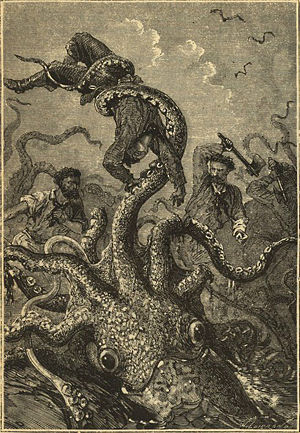
For as long as there have been fisher-folk, and contact with the ocean, there have been Sea Monsters.
Phylogeny
The "Sea Monster" preserved in the Main Street Museum collection cannot, obviously be referred to as a true Sea Monster, as it was discovered in the Connecticut River, near the White River, both fresh-water bodies. However, such nomenclature must be considered verbal shorthand. Our "River-Monster" has been determined to be of a close genetic kinship to "Champ" the Burlington, Vermont specimen, that "Lake-Monster" could be considered appropriate terminology.
Therapsida is a group of synapsids that include mammals and their immediate evolutionary ancestors. Called "half-mammals, half-amphibians" non-mammalian therapsids dating from the Early Cretaceous period show striking similarities to both the Connecticut River Monster and to scientific reconstructions of Champ.
Cadborosaurus willsi
The remains of an animal found in a sperm whale stomach in 1937 have now been accepted as a genuine reptilian sea serpent and it has been given the latin name Cadborosaurus willsi.
Press
Read our first press release about the Beast!
Read about (and buy!) the Vermont Monster Guide here, from the University Press of New England, 2009.
Cryptomundo is writing about the latest, best and brassiest book about Vermont Monsters!
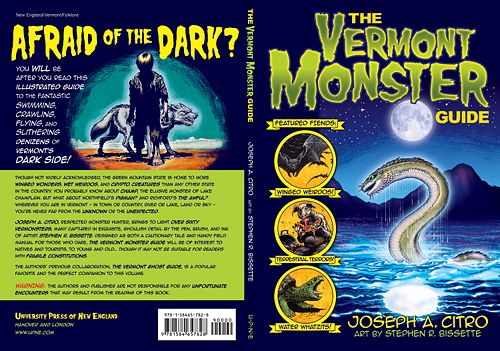
Cover of the Vermont Monster Guide, University Press of New England, 2009.
References and Links
See Monsters as only a Master of Comics could draw them here at Steve Bissette's own htmlpage!
and see Joe Citro's blogspot page here!


